

Contradictory ideas
Do you hold contradictory ideas in your head?

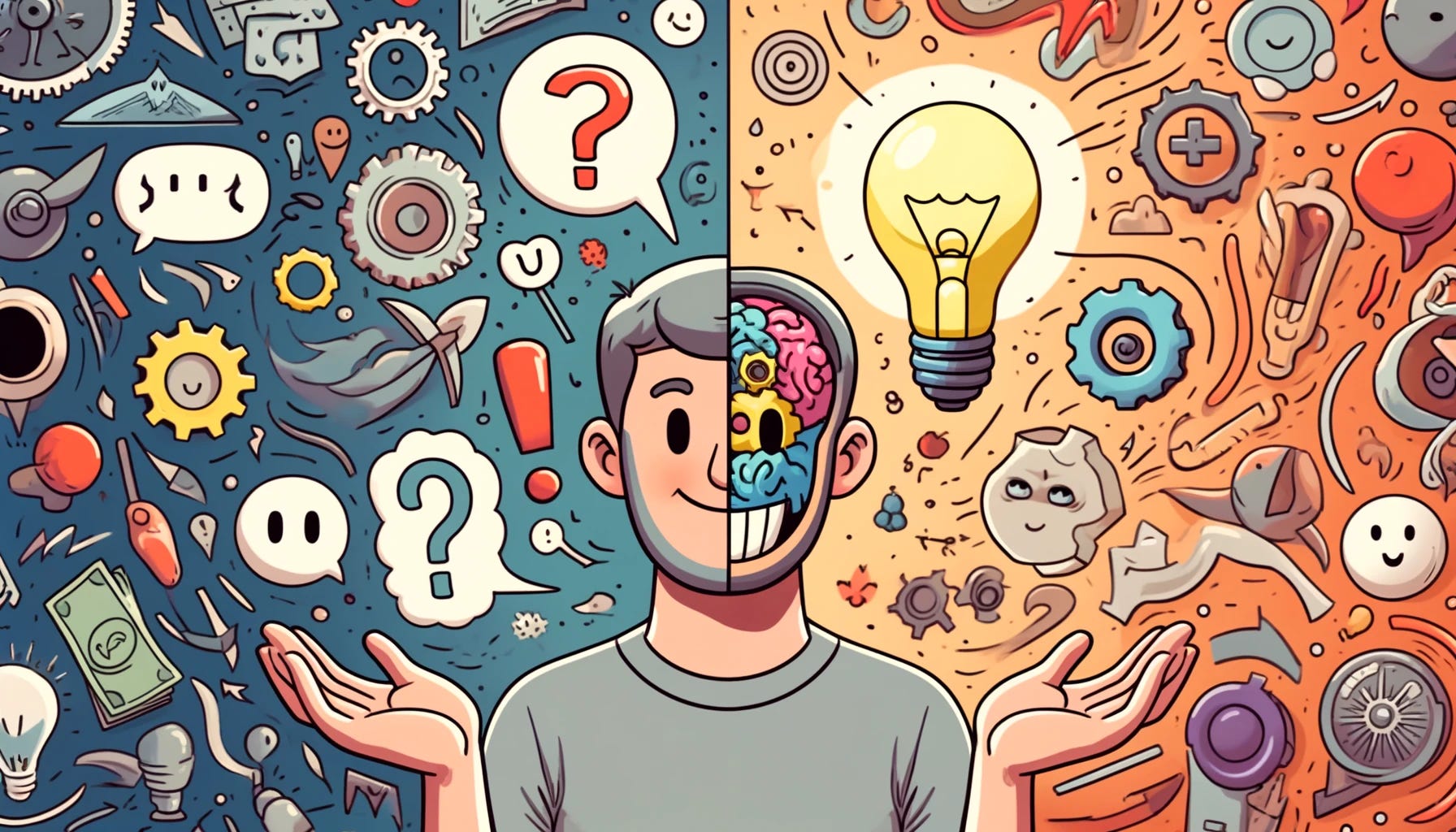
One of the reasons I love Amazon’s leadership principles is that they are often contradictory.
Here’s a couple:
Bias For Action
Deep Dive
On the face of it, they argue for opposites.
Bias For Action says speed matters. It urges you to take action without getting mired in the paralysis of analysis or waiting indefinitely for more data to make decisions.
On the other hand, Deep Dive asks you to wear a miner’s hat and go digging. It urges leaders to be in the weeds of their business, know the metrics, and use data to make informed decisions.
Eh?
Well, the hope from Amazon is that adults, with nuanced reasoning abilities, look at these rules and use them. It’s not always the case though, as I’ve seen several instances where these are weaponized to serve someone’s agenda.
People generally struggle to hold contradictory ideas in their heads.
Not a deliberate exercise in double-think
“The Ministry of Peace concerns itself with war, the Ministry of Truth with lies, the Ministry of Love with torture, and the Ministry of Plenty with starvation. These contradictions are not accidental, nor do they result from from ordinary hypocrisy: they are deliberate exercises in doublethink”
― George Orwell, 1984
The world is full of contradictions. This, however, does not mean we do justice to contradictory ideas.
There are two approaches to contradictory ideas:
The hypocrite’s approach
The rationalist’s approach
The hypocrite’s approach is one of double talk. Opposition politicians who are accused of corruption are no longer in the eye of the storm after they join the party in power. Contradictory, sure. But this is just being dishonest.
The rationalist’s approach, on the other hand, is to establish frameworks on how and when decisions fall under either of these principles. The rational approach recognizes the paradox of ideas even while picking one to serve the moment.
The extreme version of the rational approach would be to look at the context and pick the right principle for that given moment. None of us can do this 100% of the time because we have our identities linked to ideas.
But we can try.
The violent contradiction of truth
“I believe that truth has only one face: that of a violent contradiction.”
― Georges Bataille
Idealogical extremism is more common now. In politics, religion, classism, economic models, freedom, sexuality, etc., people pick a side and that becomes their bastion of ideology. I have this too.
I intensely hate strongly conservative political parties and this makes me averse to ideas from that side, whether it is the party in power in India or the right in the US.
But there are areas where I hold contradictory views in my head. I believe all of these to be equally true:
Religion may be a necessity because humans have a spiritual yearning (a God-shaped hole in the soul) <———> Religion is an evil responsible for countless deaths and hardships and it keeps people in control (opium of the masses)
Capitalism has been the most reliable economic system for raising global prosperity and happiness around the world <———> Capitalism has been responsible for creating a huge class division making have-nots suffer more and creating a soulless existence
People have unique skills and some are just better than others in each area - meritocracy is relevant and important <———> Privilege plays a big part in allowing people to shine and rise and therefore we must acknowledge and not go maximalist on merit
The US as a force shaping the world over the last several decades has been net-positive for the world <———> The US is an imperialist dominant power that uses any means necessary to maintain its superiority
There is no free will - the butterfly effect and connectedness propel us forward <———> We can significantly change our lives but a few big decisions that we actively take
This allows me to be supremely annoying to N by playing the devil’s advocate in a lot of debates. It occasionally makes me come across as someone who doesn’t take a stand on topics. I do take a stand though, but it’s heavily context dependent. Who is making the argument, what’s their motivation, what’s their context and what’s the setting and outcome all matter.
Also, I am often wrong.
Zero contradiction ideas
However, there are some ideas where there is zero contradiction in my head (I have absolute belief in these even if not justified):
Wars are futile and evil and there is no heroism in it; It’s mankind’s worst creation.
Freedom is inherently good - the more the better; even if it creates chaos in the short term.
Science is the most trustworthy way we can all evolve as a species; There is only one science - the scientific method.
The biggest oppression on our planet is that of women, but it doesn’t get as visceral a reaction as other oppressions.
Your self; Your other self
Holding contradictory ideas is a good thing. Or it could make you slightly mad.
However, in the age of social media, extreme positions get engagement. Once we’ve taken a position, and gotten the sweet juice of validation, we then look for data to affirm it more and more. Until the idea becomes us.
“He’s the destroy billionaires guy”
“She’s the meat-is-evil gal”
In these caves, we find a tribe and once we do, we begin to look at other caves with suspicion and distrust.
I do the following to nurture contradictory positions:
Talking to people with the opposite position (not on social media but in real life)
Taking the opposite position in discussions just to see how it feels if you took it
This creates a safe space for both positions in the head and makes us comfortable.
The hardest part is not belonging to a tribe. Having gotten fist bumps from a group of people on taking a position, taking an opposing stand in a different context would be extremely hard. It’s very likely you piss off the tribe that gravitated to you.
It’s lonely and I don’t have a solution for it.
More practical contradictory ideas abound in business and daily life.
Here’s a more relevant product example:
Customers do not know what they want
Customers will tell you exactly what they want with data
Both are true.
The question is, when thinking of a feature or a new product, which of these two tenets apply? If you are the type who falls into one of these buckets always, you’ll end up making some amazing and some terrible decisions. However, if you start trying to build a framework for when more of one of them applies than the other, it starts to become easier.
Do you hold contradictory ideas in your head? What are they? And if so, how do you apply them in your life?
Could be Worse / Could be Better,
Tyag
Love this. What's your distinction, if any, between contradictory ideas and paradoxical ones?